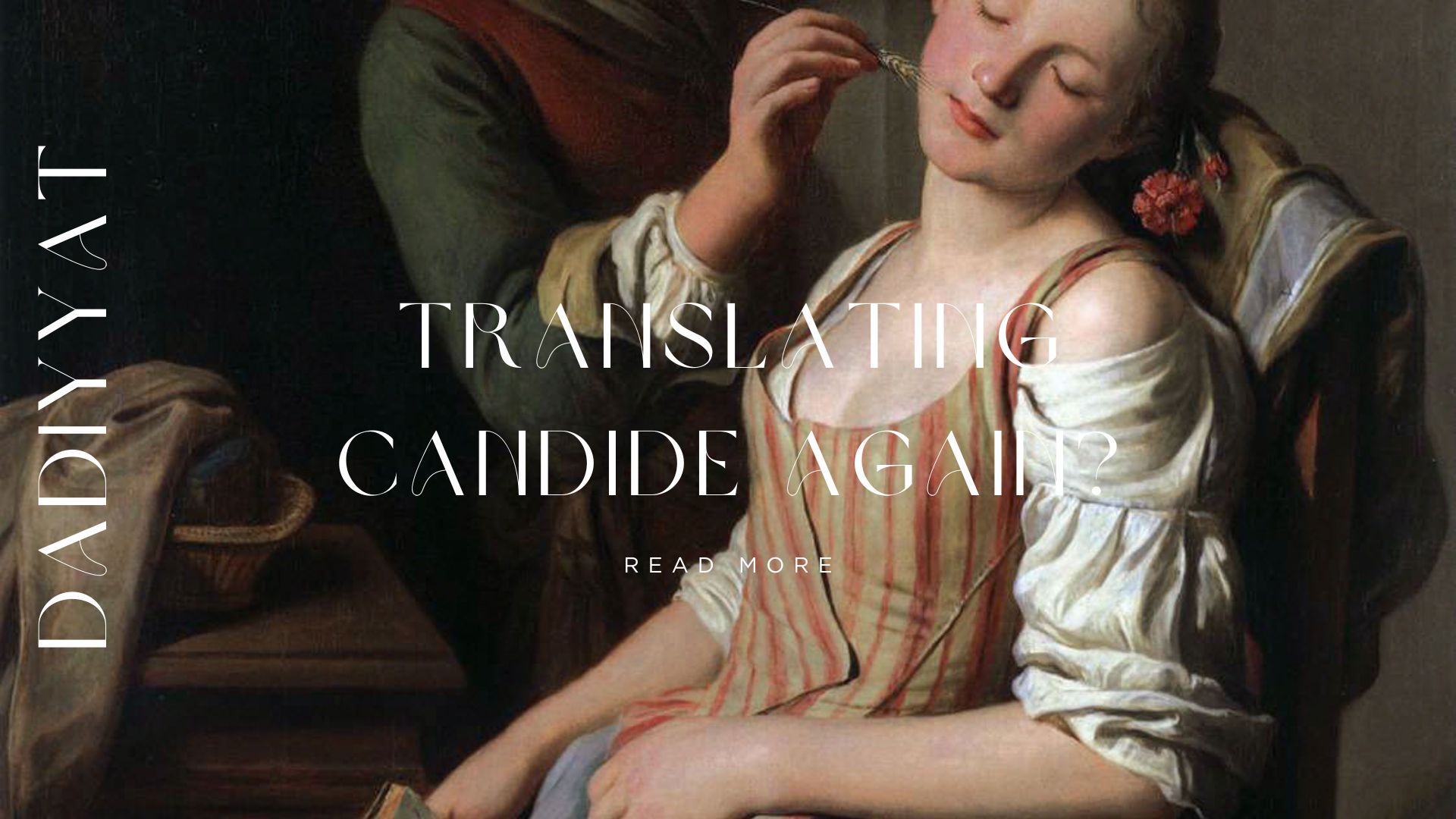
Candide (full title: Candide, ou l’Optimisme) is Voltaire’s seminal 1759 Enlightenment satire that uses dark humour and philosophical adventure to critique Leibnizian optimism, religious hypocrisy, and human suffering. This new bilingual translation bridges the gap between historical context and modern readability. By pairing a fresh English translation alongside the original French text, deep literary analysis, and historical commentary, this edition translates both Voltaire’s words and his underlying subtext. Key Highlights of my Translation include:
- Contextual Annotations: Extensive historical and intertextual commentary that decodes Voltaire’s 18th-century political, philosophical, and personal references for modern readers.
- Dual-Language Format: Designed for parallel text study, language learners, and literary scholars.
- Structural Fidelity: Employs an original methodology named Controlled Syntactic Calque Translation Methodology (or CSCTM) to treat Voltaire’s syntax as the primary vehicle of stylistic effect.
Currently halfway through development, this project is scheduled for completion in 2027.
Why Do We Need New Translations of Voltaire’s Candide?
Candide is one of the most translated works of French literature, with its influence spreading quickly beyond France. The first English translation appeared shortly after its 1759 publication, with Tobias Smollett’s version becoming particularly influential. Over time, translations have evolved, influenced by the new standards of translation set by Translation Studies to the original text, as seen in Richard Aldington’s 1928 translation. Later, Roger Pearson’s (2005) and Theo Cuffe’s Penguin Classics edition (2005) further developed this by including introductions and critical essays, presenting Candide as both literature and an object of intellectual study.
The repetitive interest in this work highlights the importance of Candide in literary education, as it serves as an entry point into eighteenth-century debates on philosophy, religion, politics, science, colonialism, and the literary canon, for many unfamiliar readers due to its accessibility. Different translations illuminate aspects of Voltaire’s work: some prioritise reading pleasure and fluency, while others emphasise linguistic precision and contextuality. However, these approaches often contrast, forcing readers to choose between literary experience and analytical understanding. This edition aims to merge these dimensions through a bilingual translation that allows literary enjoyment and interpretative analysis to coexist.
What Is Included in the Across the Channel Edition of Candide?
The edition features fifteen interconnected apparatuses, combining literary interpretation, historical, political, philosophical, and intertextual analysis, with detailed linguistic notes on significant terms and translation choices. It includes appendices with maps, descriptions of locations in the narrative, visual material on Candide’s reception, a character guide by importance, and an introduction situating the work within Voltaire’s writings. The bilingual format allows readers to engage with both the original French text and the English translation, suited for digital or print reading.
The translation follows a specific methodology (named controlled syntactic calque methodology, or CSCTM); its main feature is to preserve structural fidelity, therefore treating syntax as a primary vehicle of its effect. Like any translation methodology, this approach involves choices and limitations. Preserving elements of the original structure can create greater density in English, while maintaining certain ambiguities requires interpretative judgement. These challenges are accepted to create a translation that allows modern readers to experience Voltaire’s narrative and the stylistic features that make Candide distinctive. This edition is the first project of the Across the Channel series, aiming to apply this approach to other major works of French literature.
Finding a Publisher for Candide: Status and Expected Release Date
The project is currently halfway through development and is scheduled for completion in 2027. As the first volume of the Across the Channel series, this edition represents the beginning of a larger ambition: creating a series of bilingual editions of French classics following the same reasoning.
A two-page sample translation is also available above. I am currently seeking opportunities to collaborate with publishers and partners interested in developing of this project; for further information, samples, or collaboration enquiries, please get in touch through the contact page or directly by email.
About me
My name is Zina, and I am a translator who has a particular interest in literary and editorial translation. I write (or at least try to write) in Arabic on this blog about literature and translation. You can find out more about my work on LinkedIn or on this blog. 🤗
Image Credits
This is a faithful photographic reproduction of a two-dimensional, public domain work of art. The work of art itself is in the public domain because the author died in 1762, so this work is in the public domain in its country of origin and in other countries and areas where the copyright term is the author’s life plus 100 years or fewer. The original work was authored by Pietro Rotari.


اترك رد